


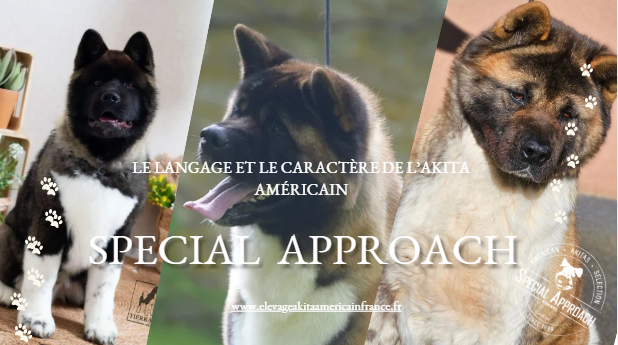
Le caractère de l’Akita Américain
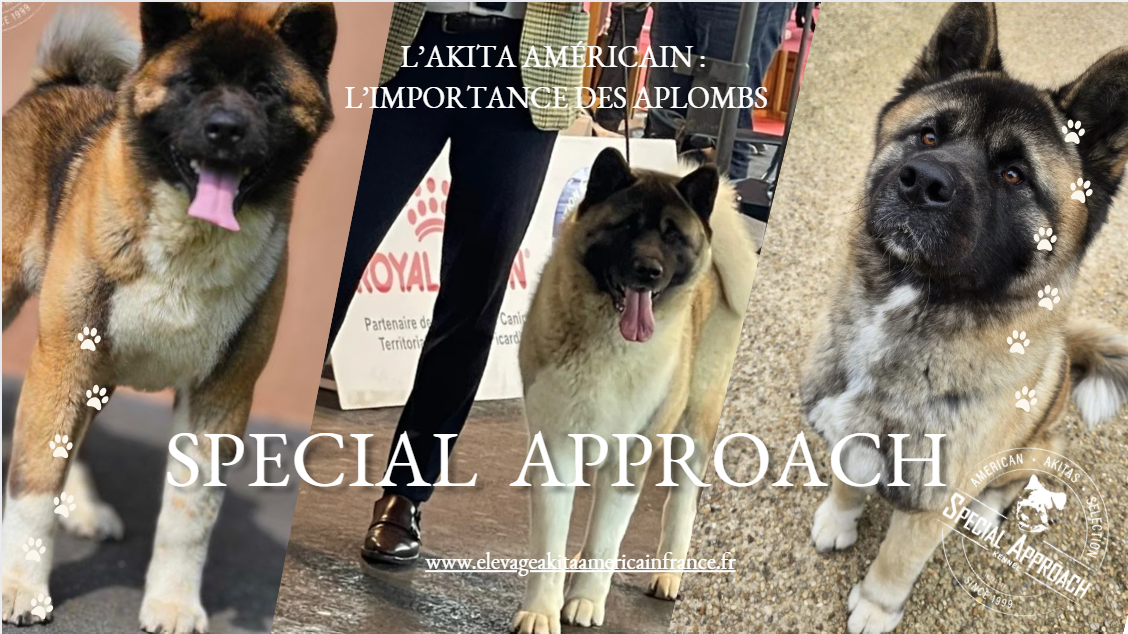
Les aplombs chez l’Akita Américain
The Akita Primitive Dog
Learning more about the character of the American Akita means first and foremost understanding its nature.

Gathered together for their ancestral history of domestication and the sometimes still very strong preservation of their primal instincts, some 48 breeds make up Group 5, known as "Spitz and Primitive Dogs." Among the best known are our favorite, the American Akita, its cousin the Akita Inu, the Siberian Husky, the German Spitz, the Shiba Inu, the Samoyed, the Mexican Hairless Dog, and others. This breed group corresponds to a classification based on the morphological characteristics, natural abilities, and ancestral functions shared by certain dog breeds. Thus, the Fédération Cynologique Internationale (FCI), which originated this division, recognizes ten groups, including this current Group 5: Spitz and Primitive Dogs.
Spitz and Related Breeds
With the exception of a few from Western Europe (Germany and Italy), the majority of Spitz and related breeds originate from Asia. Easily identifiable by their tail curled over their backs, their triangular ears, and their finely defined heads, they charm with their graceful gait and fluffy appearance... but they hide a strong personality beneath!
What do we call a primitive dog, and why?
What designates a breed as primitive is, first and foremost, because they are very ancient dogs. They have undergone little or no modification by humans; in other words, they have not undergone genetic modifications by breeders. These modifications have remained faithful to their original form, retaining the original physical, psychological, and cognitive characteristics with which they were bred centuries ago.
Secondly, these are dogs with more pronounced and developed instincts than other dogs. Primitive dogs are often extremely alert and astute animals who will use all their senses. There is also a tendency toward aggression toward their peers, which is why it is essential to socialize them early!
Behavioral Distinctives
It is mainly in this aspect that primitive dogs generally stand out most from other dogs. Indeed, primitive dogs are often considered more difficult, more stubborn, more prone to running away, more "everything," in truth.
Well, this is actually not far from the truth because these dogs, unaffected by selection and genetic modification, have retained their instincts, sometimes very markedly. In fact, they are quite often more independent, more cautious (humans/objects/food), with a stronger predatory instinct, and they will also be more guarding... etc. In short, depending on the purpose for which they were manufactured and designed, this will define their attitude and character. And although they remain dogs, their behavior often resembles that of wild canines such as wolves or even foxes, for example. Primitive dogs are said to be more inclined to survive alone in the wild.
They often originate from regions where the climate and living conditions are harsh, and where the survival instinct is absolutely essential. Japanese dog breeds faced harsh temperatures and had to be skilled at hunting wild boar or bear in very remote and difficult-to-access areas.
These dogs are not suitable for just any owner because, even though they remain dogs, their training requires a great deal of patience, rigor, and consistency to achieve results.
However, it should be remembered that a dog's behavioral characteristics are very rarely innate; it is more through life and experiences (good or bad) that an individual's personality is shaped.
Your Breeder: Éric Emonnot